
France's Prime Minister supports suspending Macron's retirement age changes to save governing coalition

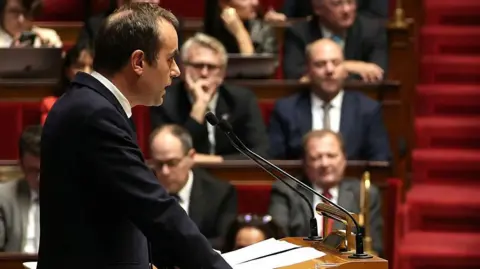
France's PM Sébastien Lecornu has informed lawmakers that he backs freezing contentious 2023 pension reforms, preceding critical votes of no-confidence later this week.
The changes, which increased the pension age from 62 to 64, were regarded as signature measures in Emmanuel Macron's term.
"During autumn I will propose to the assembly that we halt the retirement age changes until the [2027] presidential election," Lecornu declared to approval from progressive factions.
Lecornu was reinstated recently only four days after he left office, and needs the approval of Socialist MPs in the assembly if his cabinet is to survive.
Parliamentary Dynamics
Other factions on the right-wing and left-wing have initiated no-confidence motions on the cabinet, for this Thursday and are demanding new elections.
The Left-wing group announced they would be prepared to back the cabinet, but only if it guarantees a complete freeze of the president's pension changes.
"Should he fail to clearly state the words 'immediate and complete suspension of the pension reform', it will be censure," Socialist MP Laurent Baumel commented on national media.
"His fate lies in his destiny in his own hands. He understands what he has to do if he seeks to prevent being the government leader who steps down every week."
Previous Context
The changes were finally approved parliament in spring 2023, fewer than a year after Macron was voted in for a another term.
There had been a lengthy time of political debate, labor protests and civil unrest, and in the end the proposal had to go through without a parliamentary approval in parliament using a constitutional mechanism known as article 49.3.
Recently, the Prime Minister said it was something many French people recalled as a "wound on democracy" .
Economic Consequences
On this week he clearly stated to lawmakers that halting the retirement changes would require millions in 2026 and a extra billions in 2027. This will have to be "offset through other budget cuts," Lecornu said.
Lecornu is France's third prime minister in the last twelve months but even if he remains in office he needs to get a budget through parliament that reduces a budget deficit projected at over five percent of economic output this year.
France's national debt earlier this year stood at 3.4 trillion euros, or approximately 114% of GDP, the third biggest in the European monetary union after the Greek economy and the Italian nation.
Political Strategy
The Prime Minister has been one of the president's strongest supporters, so his move to reverse course on such a contested policy shows how eager the president is to prevent additional turmoil.
Philippe Aghion, who was jointly awarded the Nobel Prize in Economics on recently, said earlier that he also backed a suspension of the retirement changes, because it would still represent a reduced impact than the government collapse that would come after another administration failure.